Rehabilitation Therapy for Dogs

Christine Hibbard, CTC, CPDT-KA

Dr. Kari Johnson, DVM

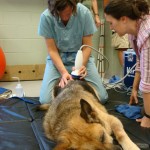
Many of the medical treatments that have been available to human patients are more commonly becoming available for our pets. In fact, some research being done at veterinary schools like Purdue and research centers in veterinary oncology are furthering human research and treatments. When I got curious about water therapy and physical rehabilitation, I reached out to my referring veterinarians. I was lucky enough to meet and interview Dr. Kari Johnson, DVM. Dr. Johnson is on her way to becoming Certified as a Canine Rehabilitation Practitioner. I met with her in her office at Animal Surgical Clinic of Seattle and she explained her work while I observed her working with a Boerboel Mastiff client whose owner brought her dog for underwater treadmill rehab post knee surgery but was continuing with the therapy because of the ongoing benefits.

When Dr. Johnson introduced herself to me, I noticed two things: her calm, warm demeanor when she introduced herself and that she was wearing a bait/treat bag. Any of you familiar with our work at Companion Animal Solutions know how much we love seeing positive reinforcement being used with pets! While Dr. Johnson filled the treadmill tank with warm water with her client dog inside the tank, she began educating me about veterinary rehabilitation therapy:

[Read more...]

Post to Twitter Post to Delicious Post to Facebook Post to StumbleUpon

Indoor Cat? Outdoor Cat? Why Choose?

Cats climbingChristine Hibbard, CTC, CPDT-KA, Katherine Ayres, PhD

We know that outdoor cats live shorter lives subject to disease and injury, yet many cat owners believe that their cats cannot be happy unless they go outside. I think one of the reasons people believe this is that many cats suffer from environmentally deprived environments without their owners even knowing they could be doing more for their cats. The added benefit is that spraying/marking, aggressive behaviors, excessively rough play and scratching of furniture and walls which are common complaints from owners of indoor cats can be helped or eliminated by following our recommendations.  Try some of these  ideas and see if they don’t make you and your cat happier:

Climbing/Viewing: If you live in a multi-cat household, providing vertical territory is especially important. Providing climbing opportunities can help alleviate cat/cat aggression and spraying/marking problems. Cat window perches, towers and condos allow your cat to jump and climb, which is especially appreciated near a window.  If you shop around, you might be surprised, cat trees have come a long way. For fashion conscious owners, we recommend installing floating shelves in a stair step pattern. Shelves can be purchased to match any decor. When you bring a new cat tree into the house or install shelves, spray them with Feliway to help your cat relax around the new item. You can further encourage your cat’s use of trees or shelves with catnip or treats. [Read more...]

Post to Twitter Post to Delicious Post to Facebook Post to StumbleUpon

Introducing Dogs to Other Dogs

Christine Hibbard, CTC, CPDT-KA

First impressions count. This is as true for dogs as it is for us. Taking some time to think through how to introduce dogs appropriately can mean the difference between dogs learning to be friends or ending up in a situation where you’re trying to overcome distrust and fear when the dog/dog greeting goes wrong.

Off Leash Introduction
I prefer off leash greetings if at all possible since all dogs are more reactive on leash than off leash. Off leash introductions alleviate two potential problems: [Read more...]

Post to Twitter Post to Delicious Post to Facebook Post to StumbleUpon

Do You Dread Going to the Veterinarian?

Christine Hibbard, CPDT-KA and Anna Baxter, LVT

Do you dread trips to the veterinarian with your dog or cat? Do you wonder if the veterinarians and vet techs dread your visit as much as you do? The veterinary staff needs to be able to perform thorough examinations, provide treatments and perform procedures. How can they be expected to do their best work if they’re fighting your pet every step of the way? It’s stressful for everyone but it’s also unfortunate because it doesn’t have to be this way. With some preparation and training time, you can dramatically lower the stress experienced by your pet, you and the veterinary staff.

Cats

Most dogs love riding in the car but most cats only ride in the car when they’re going one place, the veterinarian. Since safely transporting a cat in the car involves putting them in a carrier, preparing some cats for a trip to the veterinarian can require a bit more preparation. [Read more...]

Post to Twitter Post to Delicious Post to Facebook Post to StumbleUpon

CAUTIONWALKER Safety Leash

Christine Hibbard, CTC, CPDT-KA

I chose to devote my career to working with anxious, fearful and aggressive dogs. If you read the articles I post here and in our newsletter that include Why Dogs Bite, What Is a Reactive Rover, Dogs Biting Children, well, you get the idea. I know many wonderful trainers who also work with fearful dogs and when we get together, we bemoan how clueless people can be when approaching a dog they don’t know. We spend an unbelievable amount of time coaching owners of fearful dogs on how to protect their dogs on walks. Some of our suggestions have included body blocking, using the crossing guard ‘STOP’ hand signal, crossing the street and telling strangers that their dog has a contagious skin disease (thanks Nicole Wilde). So when I saw a post on Facebook about a new product called the CAUTIONWALKER Safety Leash, I was on that web site in a matter of seconds to check it out. When I emailed the CAUTIONWALKER Safety Leash company, Matt Cunningham replied back to me and he sent me one so that I could try it for myself.

The first thing that impressed me about this leash is the quality:

  • It’s made of really thick nylon. Their web site says “Same sturdy construction as truck cargo straps” and they are not exaggerating.
  • The stitching is well done.
  • It has a sturdy handle and swivel clip that attaches to the dog’s collar.
  • The CAUTION tape look is completely authentic. It’s large enough and bright enough to be seen at a distance.

The price is very reasonable at $17.99 with free shipping and they offer “Bulk discount for vets, pet stores and dog-training professionals”. Their web site is clear, easy to read and addresses the issue of child safety. Do you really want strangers approaching your kids if they’re walking the dog?

My only minor criticism of this new product is that the leash is just over two feet long. I understand why they made the decision to keep the leash short. My owners are so nervous that they’re clutching the leash and reigning the dog in as close to them as possible but that’s part of what we try to get them over: “relax”, “nice loose J in the leash please”. That being said though, there’s no reason you couldn’t buy a splitter or extender if you really want the additional length.

I was a Senior Quality Assurance Manager before changing careers to dog training and animal behavior which means it takes a lot to impress me with any new product and the CAUTIONWALKER Safety Leash impresses me. I LOVE this new product and can’t wait to start using them with our clients.

Post to Twitter Post to Delicious Post to Facebook Post to StumbleUpon

Barking Dogs: Make It Stop!

Christine Hibbard, CTC, CPDT-KA

In my post Control Your Dog’s Barking, I discussed the most common reason owners complain about their dogs barking, Alert Barking. In this post, I wanted to talk about some of the other reasons that dogs bark and how you can stop the barking as effectively as possible.

Separation Anxiety/Distress
If your dog is barking all day while you’re gone, that’s a type of separation anxiety. While it may be tempting to use a bark collar (spray or shock) to simply shut off the behavior, we strongly recommend that you do NOT do that. Separation anxiety/distress is a type of panic disorder so using aversives or pain to simply shut it off can cause more damage to your dog in terms of behavioral fallout (increased anxiety and fear).

If you’ve received a neighbor complaint about your dog barking “all day”, it’s time to set up a web cam and observe your dog’s behavior remotely. Neighbor reporting is sometimes unreliable as one hour of barking can seem like all day if you’re the neighbor having to listen to the barking. If your dog really is barking all day, that means your dog is suffering. The first thing you can try is to stop feeding your dog out of a bowl and put their food in puzzle toys. Let them eat their meals while you are gone. You can see our favorite work to eat toys here. If  your dog will not eat while you’re gone, it’s time to call a professional to help you counter condition your dog’s panic disorder. If you want to know what protocols work for treating separation anxiety, we recommend I’ll Be Home Soon by Patricia McConnell, PhD, CAAB or Don’t Leave Me by Nicole Wilde. [Read more...]

Post to Twitter Post to Delicious Post to Facebook Post to StumbleUpon

Catapalooza at Seattle Humane Society

Christine Hibbard, CTC, CPDT-KA

13212 SE Eastgate Way, Bellevue, WA 98005

The Seattle Humane Society is conducting the 6th annual Catapalooza event in the Factoria neighborhood of Bellevue, Washington on August 13th and 14th. We’re excited to be participating again this year along with other cat behavior professionals. If you’re interested in cat behavior, speakers will be giving presentations on everything cat:

Saturday, August 13th

11:00 How to Make a Happy Home for an Indoor Cat by Dr. Cori Gross, DVM
12:00 Cat Behavior and Mis-Behavior by Christine Hibbard, CTC, CPDT-KA
1:00 Litter Box by Wailani Sung, DVM
2:00 First Impressions Count! Cat/Cat and Cat/Dog Introductions by Christine Hibbard, CTC, CPDT-KA
3:00 Clicker Training for Cats by Wailani Sung, DVM
4:00 Tellington Touch for Cats by Emily Keegans, CTC, CPDT-KA

Sunday, August 14th

11:00 Environmental Enrichment: Reducing Behavior Problems and Saving the Environment by Christine Hibbard
12:00 Kitten Basics: Litter Box, Appropriate Play, Socialization, Handling by Jennifer Schneider
1:00 Litter Box by Wailani Sung, DVM
2:00 Tellington Touch for Cats by Emily Keegans, CTC, CPDT-KA
3:00 Clicker Training for Cats by Wailani Sung, DVM
4:00 Tellington Touch for Cats by Emily Keegans, CTC, CPDT-KA

It’s not all serious topics though. There are plenty of fun activities for the entire family!

  • Face painting, cat-toy making and education stations for kids
  • Cat-centric art, treats, leashes, collars and more!

You can read more here. Come on out and see us!

Post to Twitter Post to Delicious Post to Facebook Post to StumbleUpon

Animal Behavior Lectures available on DVD

Christine Hibbard, CTC, CPDT-KA

We offered a workshop Animal Behavior for Veterinary Professionals in Seattle. We invited veterinarians and vet tech to attend lectures by Dr. Louisa Beal, DVM, Jim Ha, PhD, CAAB and yours truly. We had a great time meeting our veterinary colleagues, learning about the issues they deal with in their practices and answering questions.

But wait, it gets better! We were fortunate to have the Tawzer Dog people at our workshop to film our presentations. Everyone at Tawzer Dog was an amazing professional and made the experience a genuine pleasure for all of us. Now our lectures are available for purchase or rental at TawzerDog.com. They have recently launched a service modeled after NetFlix where for a small, monthly fee, you can rent DVDs by Veterinarians, Certified Applied Animal Behaviorists and Certified Professional Dog Trainers. Tawzer put trailers together for us on YouTube:

Behavioral Genetics of Dogs and Cats by Jim Ha, Medication for Animal Behavior Problems by Louisa Beal, Confrontational Behavior Modification Techniques by Jim Ha and Recommended Behavior Modification Protocols and Outcomes by Christine Hibbard.

If you like what you see and you’d like to rent or purchase any of these lectures, visit TawzerDog:


Post to Twitter Post to Delicious Post to Facebook Post to StumbleUpon

Helping Dogs with Noise Phobia

Christine Hibbard, CTC, CPDT-KA

If your dog suffers from noise phobia, you know that it is a serious condition. Dogs don’t just “get over” noise phobia with time and enough exposure. In fact, we have documented cases where dogs got continually worse over time and even began generalizing their fear to other stimuli. An example of this is a dog who is afraid of fireworks that over time, becomes afraid of the backyard. If your dog is suffering, there are things you can do to keep your dog safe and even help them feel better.

Desensitization and Counter Conditioning
Begin by purchasing/downloading recordings of sounds.  You can purchase a fairly comprehensive set of sounds via iTunes (buses, trucks, honking horns, construction sounds, etc). Legacy Canine sells a CD that comes highly recommended.

[Read more...]

Post to Twitter Post to Delicious Post to Facebook Post to StumbleUpon

Adopting a New Cat

Christine Hibbard, CTC, CPDT-KA

National Adopt a Cat Month means that many of us will either be introducing a new cat to our home or at least contemplating whether adopting a cat is a good idea. Cats are very different from dogs in that regardless of whether you’ve socialized your cat well as a kitten with other cats/dogs, not all cats adapt well to a new feline family member. The good news though is that most cats learn to adapt and even enjoy one another if introduced properly and over a long enough period of time. Here are the tips we give owners for increasing the chances of a successful cat adoption:

Kittens

What is cuter than a kitten? One that gets off on the right paw! Set up a management area for your new kitten which contains food, litter box, hiding places and toys. Do not let your kitten have free access to your home since it’s easy for a young kitten to get lost and forget where their litter box is located. Over a few weeks, slowly increase the range of your home you make available to your kitten. As you expand the area of your home, add additional litter boxes. There should be at least one litter box per cat, per floor. If you catch your kitten using the litter box or scratching at their scratching post, give them a treat or a play session with you when they’re finished. Reward the behavior you want and you’ll get more of it!

[Read more...]

Post to Twitter Post to Delicious Post to Facebook Post to StumbleUpon